Showing posts with label kitchen knives. Show all posts
Friday, December 30, 2011
Kitchen Tools Name List
A traditional kitchen requires more than the big appliances such as a refrigerator and an oven to function well. From long-handled spoons to colanders and sieves to different types of knives and cutting boards, a traditional kitchen contains many and varied small tools to complete all the tasks involved with cooking.
Measuring Cups and Spoons
A liquid measuring cup.
Any functioning kitchen needs to have measuring cups and spoons. Measuring cups come in various sizes and are generally made out of glass or plastic. Measuring spoons often come in nested sets, most commonly with spoons ranging from 1/8 teaspoon to a tablespoon.
Knives and Cutting Aids
A chef's knife.
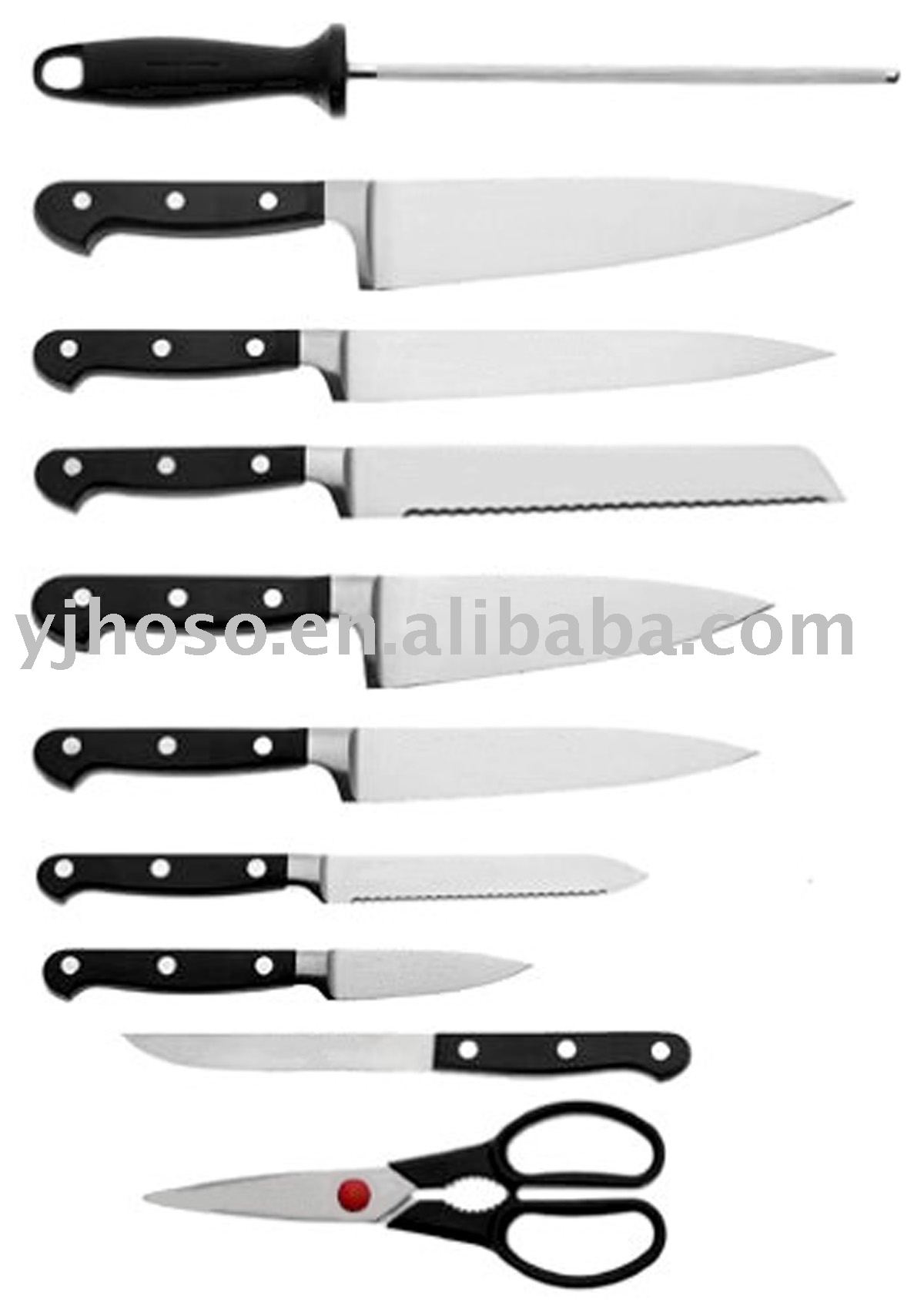
Every kitchen needs at least one large knife and a cutting board. A good basic set of knives is a regular chef's knife for everyday chopping and cutting, a serrated knife for cutting breads, a paring knife for fine cutting and peeling and a cleaver if you intend on cutting raw meats. Cutting boards are generally made from wood or plastic. Wooden cutting boards are not appropriate for meat cutting.
Spoons and Mixing Tools
A slotted mixing spoon.
In order for a cook, professional or otherwise, to properly mix things, a traditional kitchen has long-handled mixing spoons, a whisk, a slotted spoon with holes to function as sort of a miniature strainer, a soup ladle, a flexible spatula for scraping the sides of a bowl and a hand-held mixer.
Colanders and Draining Tools
Apples in a colander.
Colanders and sieves are necessary kitchen tools when cleaning fruits and vegetables or draining liquid from foods such as pasta. Metal colanders are good for draining hot foods. Sink mounted colanders and sieves with adjustable arms to fit over any sink are good for washing fruits and vegetables. Smaller sieves are good for small draining jobs and for straining foods over a bowl to catch and save liquid.
Miscellanous Tools
A rolling pin.
In addition to the above tools, a traditional kitchen also includes a peeler, kitchen shears, a rolling pin, either a manual or electric can opener, a cork screw, a grater, a vegetable scrubber, a basting brush, a meat thermometer, a basting bulb and a kitchen timer. There are many other kitchen tools that are very task specific, such as the apple corer, the garlic press and the plastic lettuce knife, and can be purchased as the need arises.
Tuesday, December 13, 2011
How To Choose The Knives You Need In Your Kitchen
A good, basic well-made set of knives is a must, for even the smallest kitchen or the most infrequent cook. They will make food preparation faster and easier. They should also last for many years if looked after correctly. There are several things to consider when choosing kitchen knives.
Types
There are many different types of kitchen knife, designed to perform a range of functions. Some of the more common ones are a chef's knife--a large, all-purpose implement, a paring knife--a small knife for cutting up fruit and vegetables, with a fine pointed end for picking out pips, a bread knife with a serrated or scalloped edge, a carving knife, which can have either a plain or serrated edge, a boning knife, with an upward-curving blade used to remove bones from meat and poultry, and a filleting knife, which has a thin flexible blade for boning fish. For all types of knife the same elements should be considered when choosing.
Blade
The blade of a kitchen knife is usually made of stainless steel. The blade will either joined to a handle or made of the same piece of material as the handle. If the blade is in the former category it should extend the length of the handle for stability. Most kitchen knives that have this feature will have rivets going through the handle and, often, a visible line of the blade along the handle's back.
Handle
The handle of the knife should feel comfortable and secure. There should be sufficient clearance so that when you grip it and chop something your knuckles do not touch the chopping board. The handle should not feel slippery if it gets wet.
Size
Hold the knife in your hand. It should fit comfortably allowing you to grip the handle with ease. It should not feel unbalanced, neither too heavy at the base or tip of the blade. Some people feel that a heavy knife makes food preparation easier, the weight doing more of the work, while others consider a lighter knife allows greater maneuverability. Choose one that feels right for you and, if relevant, the tasks you want to use it for. For instance, if you prepare a lot of meat dishes you may find that a heavier blade is more useful.
Care
Once you have chosen your knife you need to care for it properly so that it will last a long time. Try to store it separately from other kitchen utensils, either in a knife block or a magnetic knife holder. This prevents the blade from damage caused by friction with other tools. Sharpen the blade regularly for maximum performance.
High Carbon Steel Kitchen Knives Features
Kitchen knives significantly vary in price, appearance, performance and durability. You can buy them for a dollar at a deep discount store or spend up to $1,000 for one knife made by a top cutlery designer and manufacturer. High carbon stainless steel is among the top material choices for kitchen knives and, like its competitors, has pros and cons.
Advantages
Without question, high carbon steel is the best knife blade material. It is nearly indestructible, even when used to cut and chop food on metal or natural stone surfaces. It is easy to sharpen to a supreme cutting edge with a sharpening steel or other honing tools. Once sharpened, high carbon steel holds its edge well, even with repeated use.
Disadvantages
Aesthetically speaking, carbon steel gets the lowest marks. It has no stain resistance and discolors immediately upon contact with acidic foods such as tomatoes, citrus fruits, wine or vinegar. Over time, the blade will turn totally black, although the discoloration does not adversely affect the knifes cutting ability or impart foods with odd tastes or colors. High carbon steel is also susceptible to rust and requires regular scouring with stainless steel pads to keep it clean and shiny.
High Carbon Stainless Steel
High carbon stainless steel is a good alternative to high carbon steel as it is highly durable, and knives made with this material take and maintain a razor-sharp edge. The advantage it has over carbon steel is its resistance to stain imparted by the chromium in the steel. Many high-end knives are made from high carbon stainless steel. Those made in Japan typically have thinner and harder blades than knives made in America or Europe and require more maintenance.
Stainless and Surgical Stainless Steel
Stainless or surgical steel knives are low cost and their high chromium content makes them impervious to rust and stains. However, their flimsiness makes them hard to sharpen, and they do not maintain their edge because sharpening destroys the soft steel instead of creating a fine cutting edge. Professional cooks and chefs generally shun stainless steel cutlery.
Other Knife Materials
Titanium knife blades are a mixture of carbides and titanium. They have less weight than steel knives and hold an edge longer, but their flexibility makes them impractical for heavy-duty cutting and chopping. Knives with ceramic blades hold their sharp edges for months or years without sharpening, which requires diamond sharpening tools. Despite their toughness, ceramic knife blades are brittle and disposed to chipping.
Subscribe to:
Posts (Atom)